Three Success Stories for Female Education
HAVERTOWN, Pennsylvania — One day, Kumari was approached by a Field Coordinator for Educate Girls, a nonprofit that works across India to get more girls in schools. He explained that the organization was looking for well-educated young women who could persuade families to send their daughters to school. Kumari agreed to work as a volunteer in her village. Her work was difficult when she first went door-to-door to speak with families.
Saida: Borama, Somalia
Statistics show that only four percent of Somalian girls between ages 14 to 17 attend school. Early marriages specifically prevent many young girls from completing their education.
When Saida got married at 17, she thought she could no longer continue her education. Within a few years she had four children, including a set of triplets. As a wife and a mother, she had time for little else besides household chores and caring for her family.
Still, Saida refused to give up on her dream of becoming a teacher. With the help of Mercy Corps, Saida joined a female-only teacher training program at Amoud University in Borama. As of 2014, she was one of the highest-achieving women in her class. She engaged in discussions and confidently asked questions.
Once she completes the program, Saida will return to her hometown to teach at the local school. She says that she wants to use her experience to champion for girls’ education.
“I want to act as a role model for my community,” she explains. “I want to be a teacher to empower the next generation of girls.”
Navli Kumari: Rajasthan, India
Navli Kumari grew up in a well-developed district of Rajasthan. Because she lived with her father, who encouraged her to attend school, she was able to study until 12th grade.
When her father passed away, Kumari returned to live in her native village, where traditional gender expectations had kept many girls out of school. Few girls had received even primary education.
In India, over 3.7 million girls do not attend school. The Indian state of Rajasthan has nine of the country’s 26 worst gender gap districts in education.
“It was very disheartening for me,” Kumari says. “Seeing them, I often wondered how I could use my education for the betterment of my community but saw no existing avenue.”
One day, Kumari was approached by a Field Coordinator for Educate Girls, a nonprofit that works across India to get more girls in schools. He explained that the organization was looking for well-educated young women who could persuade families to send their daughters to school. Kumari agreed to work as a volunteer in her village.
Her work was difficult when she first went door-to-door to speak with families. “Many doors were slammed in my face and many abuses were hurled at me. But I knew I had to be patient and persistent,” Kumari explains.
Her persistence has paid off. After four years of volunteering with Educate Girls, she has gotten 46 girls back into school and stopped two child marriages. After years of failed attempts, her village has finally established a school.
Kumari now acts as a leader in her community; she has even decided to run as a candidate in local elections. She says that she is very proud of her work with Educate Girls, as it has given her life purpose.
Mezon Almellehan: Dara’a, Syria
Two years ago, 16-year-old Mezon Almellehan and her family fled from war-torn Syria to Jordan. Of the four million refugees of the Syrian civil war, over 600,000 have settled in Jordan.
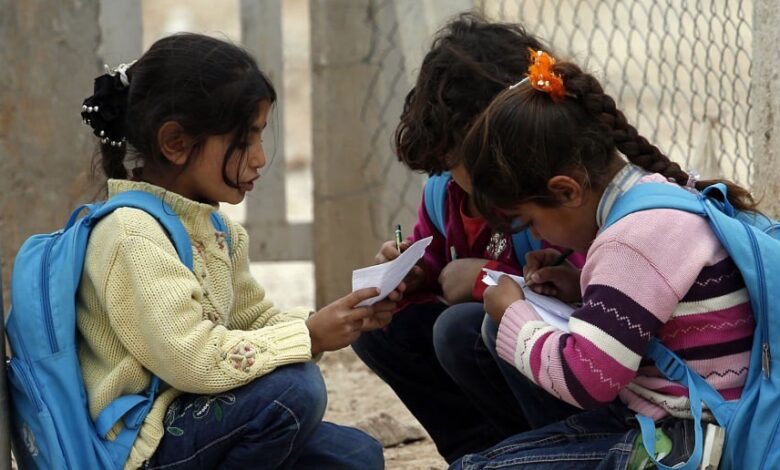
Every day, Almellehan walks from tent to tent in her refugee camp, encouraging girls to go with her to school. Some news outlets have dubbed her the “Malala” of Syrian refugees.
Almellehan does have a lot in common with girls’ education activist, Malala Yousafzai. The two became friends when Yousafzai visited the Zaatari refugee camp last year. Inspired by her work with refugee girls, Yousafzai invited Almellehan to attend the Nobel Peace Prize ceremony in Oslo with her.
Earlier this year, Almellehan moved from Zaatari to a new camp in Azraq. She acts as a role model to other girls in the camp, listening and offering advice on their studies. She talks with children who have dropped out of school, and she works with organizations that prevent early marriages.
As increasing numbers of Syrians have fled to Jordanian refugee camps, rates of child marriages have skyrocketed. Poor living conditions and strained finances prompt many families to marry off daughters at a young age. One UNICEF report found that of all Syrian refugee marriages in Jordan between January and March 2014, almost a third involved girls under 18.
“Some families do not want to send their girls to school, because they are afraid that if girls continue with their education, she will become more independent and will not follow her husband,” Almellehan explains. “Some families believe that early marriage is a good life for their child, but they never think of education as a good life for their girl,”
Almellehan says that her parents, both former teachers, support her work in the camps. She also says that she one day hopes to be a journalist. For now, she has decided to focus on school.
“With education,” she asserts, “we can solve anything.”
– Caitlin Harrison
Sources: Mercy Corps, Educate Girls, Malala Fund, The Guardian, Time
Photo: Huffington Post
[ad_2]
Read More